Posts

1885 Victorian Day Bodice Part 1

Image
Happy 1st Day of Summer! And to celebrate the Summer Solstice, today, I'm attempting to make my very first Victorian bodice. The jacket I am working on is from the Truly Victorian patterns ( TV460 ). A little bit about Truly Victorian patterns. While this is my very first time working with this brand, I will definitely say that the instructions were very easy to follow and had illustrations so I would know which piece was supposed to go where. And just like J.P.Ryan's patterns, I liked the fact that this set of patterns were on the thick butcher's paper rather than tissue paper; Simplicity and McCalls is best known for that, and given that I have a cat who likes to "help" whenever I'm sewing, tissue paper patterns is a no-go.  Anyway, now that everything is sewn and pinned together on the mock-up, now comes the decision of whether to add real or false buttons to the front of the actual jacket, to make it long sleeved or 3/4 sleeved, and most importa...

1785-1790 chintz jacket & Petticoat

Image
As a side project, I've decided to visit the style of the early 1790's, just for fun. While it's very similar to the rest of my gowns I've sewn, this one is a bit different. Unlike most of my gowns, this one will have long sleeves and the second of course is the matching chintz petticoat, rather than a solid petticoat to compliment the jacket or gown.  After sewing together the petticoat using 2 yards of the CW "wavy vines" print, I remade my jacket with the same print by recycling the train from the original gown.  My old gown before the upgrade New and improved (cat not included, but encouraged)                                         Inspiration  Back View I still have a few things I want to touch up on the jacket. Case in point, I'd like to maybe add some ruffle to compliment the petticoat and perhaps sew lace around the neckline (or a ruff...

Afternoon Tea (Knitted cozies)

Image
Being an avid tea drinker, I have accumulated a good collection of herbal and floral teas over the past few weeks. I have also accumulated a LOT of yarn over the past several years that I'm still trying to knit down or get rid of. So that brings me to getting in the spirit of making cozies for all of my mugs and teacups and my 2 tea pots (not pictured). My growing collection (you can tell mint's my favorite) Looking in my stash, I came across some 2 types of roving that needed to be spun into yarn (to help with destashing). They turned out to be a beautiful dark purple, and peacock-blue. Afterwards, I spun them both together in 2 ply to make them a thicker fingering yarn rather than cobweb. If you'd like to make your own cozy, here is the link . The needles I used was a size 3 to make the gauge a lot smaller, rather than the larger sized needles the instructions calls for. 

1770's Chintz Pinner Apron

Image
Reflecting on my recent trip to the DeWitt Wallace museum, I couldn't help but to be enamored over this beautiful apron. While I'm not 100% certain if it's an original piece or a very good reproduction, the description on the side, showed that that the chintz print was mostly preferred however there is documentation and fashion plates of women wearing pinner aprons made of other fabrics such as black silk or cotton fabrics (striped, checked, or a solid color). This particular apron is a medium block print that a middle class woman could easily afford and construct on her own if she could sew. Like all fashionable aprons, the pinner apron had a duo purpose: to protect the lady's garment and to be a fashionable accessory. The more I looked into it, the more I became interested in making it my next sewing project. Pinner Apron Examples Black Silk Blue-Checked Block Printed Chintz      Block Printed Chintz; Featured in the Texti...

Colonial Williamsburg Internship Week 4

It's been an interesting lesson this week, and surprisingly it didn't come from the Milliner shop. What did I learn you ask?  I've learned that during summer, Virginia's heat and humidity will get the best of you if you do not stay cool and hydrated. I learned that lesson the hard way, this week. After days of not properly hydrating (drinking water) and only drinking teas and not being in the A/C as much as I should have been, Thursday's hot temperature took a toll on me. Even though the shop had the AC running, we had at least 20-30 bodies coming in constantly, making the shop hot. I began to feel sick and weak and overheated. Eventually I ended up going home and spend several days recovering and rehydrating. I immediately called my husband who was away on a military exercise, and was given plenty of information on what to do and what else to look for symptoms wise. I think the lesson from this week, is to stay hydrated even if your'e not thirsty, and...

Chintz print Housewife

Image
About 2 weeks ago during my first few days in Colonial Williamsburg, I saw the newest issue of Trend & Tradition and was enamored by this cute little housewife (sewing kit) that was featured in one of the articles; it even came with directions on how to make your own! Needless to say, it was very popular among some of the interpreters and crafters; for example, a friend of mine who works for CW is in the process of making her second one. After she showed me her beautiful work, I immediately made up my mind and attempted to make one just for the fun of it.  While there are some similarities between mine and the one featured in Trend & Tradition , there are some minor differences. The magazine's version has more of a triangular top, while mine is missing. (but hey, uniqueness is a good thing 😄) Sewn together with backstitches, whipstitches, and TINY basting stitches In the near future, I do plan to do a second one but perhaps make it a b...

Colonial Williamsburg Internship Week 3

Image
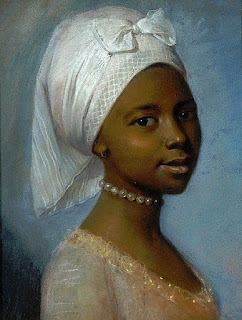
This week, I have been working on a very special research project in accordance to my sewing project at work. This week starts the subject of millinery (i.e. hat making); in the 18th century the term millinery covered more than just hats. It covered accessory items that one would normally wear day to day, including things that were out of the ordinary and fashionable necessities (like a cane sword or a new pair of stays for example). At first, I wanted to replicate a silk calash  that I've seen on sites like Pinterest as well as fashion plates that the milliner shop has available, but something else in the back office caught my eye that really resonated with me....  A picture of Jean-Étienne Liotard's Portrait of a Young Woman, painted in the second half of the 18th century. As soon as I saw this portrait, I was inspired not only to replicate her head wrap, but to also look into doing some research on African American/African/Caribbean history through 18th century fashio...