My 1st Medieval Kirtle and Surcote

This past September, seeing my friends enthusiastically prepare for Pennsic, along with my own growing interest in early historical events, strongly motivated me to join my local Society for Creative Anachronism (S.C.A.) chapter, or Baronny. Having previously focused on other periods, I became eager to explore the 14th to 17th centuries, with their rich culture, fashion, etc. As a result, joining this chapter required creating a simple yet fashionable medieval wardrobe.
I decided to go with a Kirtle: a 14th-century fitted gown, made from lightweight worsted wool, but also could be made with linen. Examining several extant examples, it could be decorated with an embroidered border, striped with a contrasting color, two-toned, or left plain. Because this is my first, I decided to stick with plain and accessorize.


CONSTRUCTING THE KIRTLE
To begin with, I had to settle on the type of fabric. As previously described, the historic options were worsted wool or natural linen. Where I live, humidity outweighs the heat in the Summer and sometimes early Autumn seasons, so linen was an obvious solution; now, with some sage advice from a dear friend, I learned that linen is not exactly a stable fabric on its own, especially when unlined; due to its malleable nature, it can't hold up on its own like wool can. So to remedy my dilemma, it was suggested that I wear a modern-day bra and my under-smock to hold the fabric in the right places.


SEWING THE SUR-COTE
When I began the design process for the sur-cote, my initial approach involved modifying a pattern I had previously used for my kirtle, with the intention of making the necessary adjustments to achieve the desired fit and style. After conducting some preliminary testing and alterations, I realized that the adapted pattern simply did not produce the correct shape and form that I was hoping for in the final garment. Luckily, my local library came to the rescue, as they had a copy of Prior Attior's Equestrian Dressmaker's Book, which contained a wealth of information and patterns specifically tailored to 14th-century garments, including the sur-cote.
As a result, this resource proved to be an invaluable tool, providing me with the accurate patterns and guidance needed to successfully complete the project. Choosing fabrics was a little easier to select; I was looking for something that would not just complement the terracotta colored linen I used for my Kirtle, but something a little heavier to both block out the wind and keep me a little warm; also something a little fancy and upper-middling (not a medieval term, I know, but you get the idea). So, to my discovery, I came across several yards of cotton quilted-esque...shower curtains (yes! You read that right!). It possessed the right kind of weight, length, and thread-count; if needed, I could throw it in the washer/dryer and not worry about it warping. It was perfect.


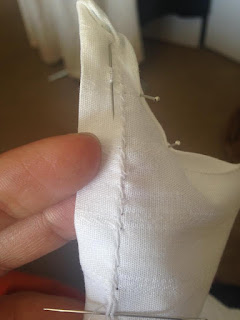
To pull it altogether, I decided to create a wimple. This was a pretty simple and quick item to make, using two 1/2 yards of cotton muslin and hemming them using a rolled hem (to really give them a cleaner look). I also created a coif that I would wear to cover my hair and then pin the wimple pieces overtop of that. Given that I have a lot of thick hair, I had to scale my pattern up a little bit more to fit the circumference of my head and hair pulled into a braided bun. Going forward, I'd like to remake my wimple using a lightweight linen fabric to give it a bit of a heavier drape and maybe make the top half of my wimple a little longer by 7/8 yards rather than 1/2.

.jpg)


Amazing Idea
ReplyDelete